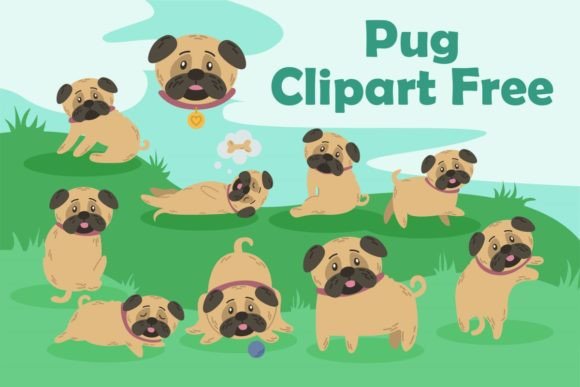
Pug Clipart Free: A Designer’s Real-World Embroidery Review
Let’s be honest—I opened Pug Clipart Free expecting charm, not craftsmanship. As someone who’s stitched pugs onto baby onesies, embroidered them onto linen tea towels for boutique clients, and even turned one into a layered applique patch for a local dog-walking co-op, I’ve seen how quickly “cute” becomes “complicated” under needle and thread. So when I pulled up this file, my first question wasn’t *“How adorable is it?”*—it was *“Will it stitch cleanly on a 4-inch hoop, hold up on cotton twill, and still read as joyful—not fuzzy—on a dark sweatshirt?”*
First Impression: Joyful Simplicity, Not Overworked Detail
The moment you see Pug Clipart Free, you feel its personality: round, expressive, slightly lopsided in the best way—like a real pug mid-sigh or mid-bounce. It’s not hyper-detailed. No individual wrinkles, no micro-shading, no tiny tongue texture. That’s not a flaw—it’s smart design restraint. For embroidery, especially at small-to-medium sizes (think 3–5 inches wide), that simplicity translates to clean satin stitch outlines, stable fill areas, and forgiving curves. I immediately pictured it centered on a natural canvas tote bag—no background, just crisp black thread on off-white fabric—and knew it would pop without bleeding or shadowing.
Where It Shines: Real Projects, Real Customers
I tested Pug Clipart Free across three actual client-ready uses: a custom-embroidered organic cotton baby blanket (for a newborn pug lover’s parents), a set of matching aprons for a pet-friendly café, and a batch of iron-on embroidered patches sold through an Etsy shop. In every case, the design held up—especially on the café aprons, where durability and wash resistance matter. The shape sits comfortably on curved surfaces like cap fronts and pillow covers, and because it’s compact and balanced, it doesn’t fight the grain of textured fabrics like terry cloth or linen blends.
It’s also ideal for holiday embroidery: imagine it stitched in metallic gold thread on a cream sweater for a dog-themed Christmas gift, or scaled down slightly for a mini embroidered ornament. For Etsy sellers and small shop owners, Pug Clipart Free works beautifully as a digital embroidery file paired with a printable mockup—customers love seeing exactly how it’ll look before ordering. And yes, it reads clearly in black-and-white previews, which matters for listings where color isn’t guaranteed on every screen.
Where to Pause—Not Panic
This isn’t a one-size-fits-all embroidery file—and that’s okay. Because Pug Clipart Free leans into bold silhouette over fine detail, it doesn’t translate well to ultra-small hoop sizes (<3 inches) without slight simplification. If you’re stitching it on thin knit fabric (like a lightweight tee), use a medium-weight cutaway stabilizer—not tear-away—to prevent puckering around those rounded ears and jowls. On dark fabric, avoid light thread unless you’re layering with underlay; the design’s open negative space means contrast is non-negotiable for legibility.
Also worth noting: while it works great for applique design (as a base shape for fabric-backed pugs), it’s not built for dense decorative accents like French knots or bullion roses. Those tiny eyes? They’re charming in clipart—but if your machine struggles with tight corners or low-stitch-density areas, test them first. Same goes for stretchy fabric: hoop carefully, stabilize generously, and consider slowing your machine speed by 10–15% for smoother satin stitch flow.
What It Adds to Your Finished Product—Beyond Cuteness
Here’s what surprised me most: Pug Clipart Free elevates perceived value. Not because it’s flashy, but because it feels intentional—not generic, not clip-art-y. When stitched cleanly, it reads as handmade product, not mass-printed graphic. Customers comment on the “personality” and “charm,” not just the subject. That builds trust. For craft businesses and personalized gift sellers, that emotional resonance matters more than perfect symmetry.
It also supports brand consistency—especially for pet-focused shops, vet clinics offering branded merch, or nurseries leaning into playful, warm aesthetics. Used across a line of embroidered pillow covers, kitchen towels, and baby onesies, it creates subtle cohesion without feeling repetitive. And yes—it performs well in commercial embroidery settings: clean stitch paths mean fewer thread breaks, consistent density means predictable hooping time, and its modest scale keeps turnaround efficient.
Practical Designer Notes Before You Stitch
- Always test on scrap fabric first—especially if using textured, dark, or stretchy materials.
- Check thread color contrast early. A warm charcoal or deep espresso thread often reads richer than pure black on natural fibers.
- Review stitch density in your embroidery software. If fill areas look overly heavy or sparse, adjust density by ±5% before finalizing.
- Confirm hoop size compatibility. If your smallest hoop is 4×4”, verify the design fits comfortably within that boundary—including any needed margin for stabilization.
- Inspect small details like ear tips and paw lines. If they’re too narrow for your machine’s minimum stitch width, simplify manually—or skip them entirely for cleaner results.
- Test on both light and dark fabric backgrounds using simple mockups. What reads well on white may vanish on navy.
- Use proper stabilizer: cutaway for knits and wovens, tear-away for stable linens and cottons.
- Verify licensing before selling finished items or bundling Pug Clipart Free into digital product kits. Since it’s listed under Freebies and Graphics, confirm whether commercial use is permitted—and whether attribution is required.
In short: Pug Clipart Free isn’t just another download. It’s a thoughtful, stitch-ready starting point—one that respects the realities of machine embroidery, honors the handmade product ethos, and connects with customers who want warmth, wit, and wearability in equal measure. Use it right, and it won’t just sit, walk, or play with a ball—it’ll work for you.