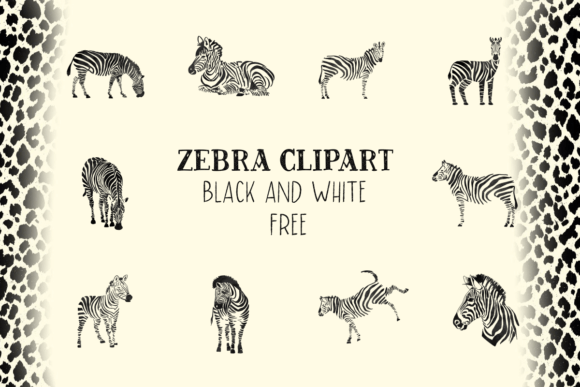
Zebra Clipart Black and White Free: Graphics for Local Business Freebies
First Impression: Bold, Balanced, and Unexpectedly Versatile
As a brand designer who’s developed identities for 17 local businesses—from lavender-scented candle studios to heritage sourdough bakeries—I opened Zebra Clipart Black and White Free expecting a predictable silhouette. Instead, I found crisp vector outlines with intentional negative space, rhythmic stripe weight variation, and subtle organic flow in the curves. It doesn’t scream “zoo animal” or “cartoon.” It whispers balance, contrast, rhythm. That makes it unexpectedly powerful for small business branding: think artisanal kombucha labels where black-and-white zebra stripes echo fermentation’s natural cycles, or handmade soap packaging that uses the motif as a quiet nod to duality—calm + energy, earth + elegance.
Where This Graphic Design Asset Fits Real Local Business Needs
You’re not designing for a stock photo library—you’re solving real problems. For a neighborhood florist launching seasonal dried-flower bundles, Zebra Clipart Black and White Free became the anchor for hang tags: scaled down to 1.2 cm tall, it held clarity on kraft paper without bleeding. For a children’s pottery studio, we layered it behind hand-lettered class names in social media graphics—adding visual texture without competing with legibility. And for a cold-pressed juice bar? We used it as a repeating border on menu boards and takeaway cup sleeves, reinforcing brand identity across touchpoints without overwhelming clean typography.
Stronger First Impressions, Clearer Visual Hierarchy
Local customers decide in under three seconds. A well-placed zebra graphic immediately signals intentionality. On product labels, it creates instant shelf appeal—not by shouting, but by offering visual rhythm that guides the eye from logo to flavor name to origin story. In packaging design, it supports stronger customer trust: consistent use across stickers, thank-you cards, and website banners tells shoppers, “This brand pays attention to detail.” That perception translates directly to perceived value—especially critical for handmade business owners pricing premium goods.
Best Uses: Precision Over Decoration
- Product labels: Works beautifully as a corner accent or vertical divider between ingredients and certifications
- Packaging accents: Adds tactile sophistication to matte-finish boxes or embossed hang tags
- Hero graphics: Scales cleanly for Instagram carousels or printed posters promoting seasonal collections
- Printable inserts: Ideal for branded recipe cards (baking), care instructions (skincare), or planting guides (botanical brands)
- Social media campaign graphics: Paired with bold sans-serif headlines, it grounds playful or nostalgic campaigns—think “Summer Stripe Sale” for a boutique or “Black & White Harvest Week” for a farm-to-table grocer
Use With Care: Context Is Everything
This isn’t a universal solution. Avoid using Zebra Clipart Black and White Free on ingredient-heavy food labels where regulatory text dominates—its contrast can unintentionally compete with required information. Skip it for luxury minimalist skincare brands relying on ultra-thin fonts and vast white space; here, the stripes may read as clutter. And never place it over low-contrast backgrounds (e.g., light gray on off-white) without testing print output first—what looks sharp on screen often softens on uncoated paper.
Practical Brand Designer Notes You Can’t Skip
- Test on real packaging mockups—not just digital previews. Print a 2" x 2" version on your label stock to check edge sharpness and ink bleed.
- Verify black-and-white usage: Confirm the asset renders true black (#000000) and pure white (transparent or #FFFFFF), especially if you’ll invert it for dark packaging.
- Preview at actual label size: At 8 mm height, does the stripe detail hold? If not, simplify or use only one stripe segment as a watermark.
- Test with your brand fonts: Does it harmonize beside a warm serif (like Playfair Display), a friendly sans (like Montserrat), or a delicate script? I found it paired strongest with geometric sans-serifs and sturdy display fonts.
- Inspect SVG editability: Open the vector file in Illustrator—can you adjust stroke width, isolate stripes, or recolor individual paths? That flexibility is essential for customizing across packaging tiers.
- Confirm commercial licensing: Even “free” clipart varies wildly. Ensure your license covers physical product sales, client work, and resale—critical for packaging designers and creative entrepreneurs building scalable assets.
Why This Fits the Real Work of Small Business Branding
Small business branding isn’t about chasing trends—it’s about finding authentic, repeatable visual tools that reinforce your story without distraction. Zebra Clipart Black and White Free succeeds because it’s both distinctive and restrained. It supports, rather than defines, your brand identity. When used intentionally—as a subtle pattern on coffee bag seals, a rhythmic divider on farmers’ market flyers, or a confident anchor in a Canva template for weekly email headers—it becomes part of your visual language. Not decoration. Not filler. A functional, flexible, professional branding tool rooted in contrast, clarity, and craft.