Cute Watercolor Sea Life Animals Clipart
First Impressions: Soft, Playful, and Purpose-Built for Gentle Projects
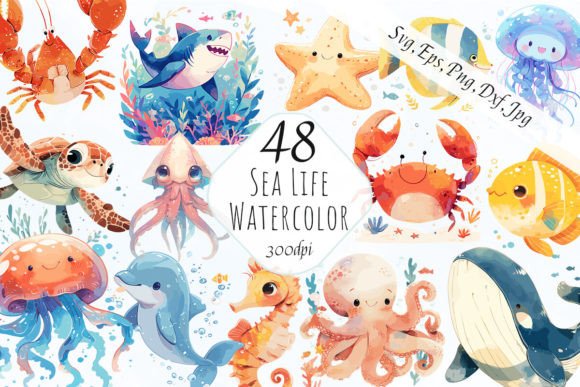
Opening Cute Watercolor Sea Life Animals Clipart, I immediately felt its quiet charm — not loud or hyper-detailed, but tenderly rendered with soft edges, subtle gradients, and that signature watercolor bleed. Think baby octopus with faint blue washes, a smiling turtle with gentle pigment pooling at the shell’s edge, or a seahorse floating mid-stitch like it’s just drifted into your hoop. It’s clearly designed for warmth and whimsy, not bold statement pieces. That makes it ideal for nursery decor, baby gifts, and small-batch apparel where customers want handmade softness — not sharp vector precision.
Real-Life Test: Embroidering a Linen Kitchen Towel for a Local Boutique
Last week, I used three motifs from Cute Watercolor Sea Life Animals Clipart to embroider a set of linen tea towels for a seaside-themed boutique. The goal? A cohesive, gift-ready look — not “craft fair busy,” but something that felt intentional and quietly joyful. I chose the jellyfish, starfish, and tiny crab. On smooth, medium-weight linen with tear-away stabilizer and 40-weight cotton thread, the watercolor illusion translated beautifully: soft satin stitch outlines gave gentle definition, while light fill stitches mimicked pigment diffusion. Customers loved how it looked — “like a storybook came to life,” one said. That’s the strength of this collection: it invites emotional connection, not just visual recognition.
Where It Shines in Embroidery
- Custom apparel — especially sweatshirts and toddler tees where softness matters more than fine detail
- Baby embroidery — onesies, burp cloths, and crib mobiles benefit from its gentle scale and non-intimidating shapes
- Embroidered patch — works well as a sew-on accent on denim jackets or backpacks when digitized with balanced stitch density
- Tote bag design — large, open areas let the watercolor flow feel intentional, not pixelated
- Holiday embroidery — think Easter baskets or under-the-sea birthday favors; it reads as cheerful, not seasonal
- Personalized gift — adding a child’s name in a simple script beside a sea turtle creates instant heirloom appeal
Where to Proceed Thoughtfully
This isn’t a one-size-fits-all machine embroidery design. Its watercolor aesthetic demands thoughtful execution:
- Small hoop sizes: Avoid cramming full motifs into 3x3" hoops — delicate pigment edges get lost. Stick to single animals at 2.5–3.5" max for clarity.
- Textured or stretchy fabric: On terry cloth towels or ribbed knit baby caps, the soft outlines can blur. Use cut-away stabilizer + reduced stitch density to preserve shape.
- Dark fabric: The pale washes fade unless you boost contrast — test thread colors first. Navy or charcoal looks stunning with ivory or mint thread, but avoid pale yellow on black.
- Curved surfaces: Caps and curved pillow covers distort soft gradients. Digitize with slightly bolder outlines or add a subtle running stitch border to anchor the motif.
- Frequent washing: Linen and cotton hold up well, but avoid dense fill stitches in high-friction zones (e.g., tote bag handles). Let the watercolor breathe — less is more.
What It Adds to Your Finished Product — and What It Doesn’t Promise
Cute Watercolor Sea Life Animals Clipart elevates perceived value through mood, not complexity. A customer buying a hand-embroidered baby blanket with this design isn’t paying for technical mastery — they’re investing in calm, care, and intentionality. That builds trust. It also supports brand consistency for craft businesses leaning into organic, nature-inspired aesthetics — think Etsy sellers with botanical + ocean themes or small shop products focused on slow-made goods.
But be realistic: it won’t read clearly on a 12"x16" wall banner from across the room. It’s not built for dense applique design or layered satin stitch effects. Its power lies in subtlety — so if your project needs bold branding or high-contrast visibility (like safety vests or event staff apparel), look elsewhere.
Practical Embroidery Designer Notes You’ll Actually Use
Before stitching your first piece:
- Test the digital embroidery file on scrap fabric matching your final product — same weight, weave, and stretch.
- Check thread color contrast early. Print a black-and-white mockup to see how light washes hold up without color.
- Review stitch density — too much fill will flatten the watercolor effect; too little risks gaps. Aim for 15–25% density in gradient zones.
- Confirm hoop size compatibility. Most motifs work best in 4x4" or larger — verify before digitizing or resizing.
- Inspect corners and fine curves. Watercolor edges soften easily — if your machine struggles with tight turns, simplify or outline gently.
- Use proper stabilizer: tear-away for stable wovens, cut-away for knits, and lightweight fusible for sheer fabrics.
- Double-check licensing. Since these are Illustrations marketed for invitations, mugs, and t-shirts, confirm commercial use rights before selling finished embroidered items or bundling as design assets.
A Final Thought for Craft Business Owners
If you’re an Etsy seller or small shop owner building a cohesive line — say, ocean-themed baby bundles or coastal kitchen collections — Cute Watercolor Sea Life Animals Clipart is a quiet multiplier. It pairs effortlessly with neutral palettes, natural fibers, and minimalist packaging. It doesn’t shout — it invites. And in today’s handmade market, that kind of thoughtful restraint often converts better than flashier alternatives. Just remember: its magic lives in the margins — in the softness between stitches, the quiet joy of a well-placed starfish, and the confidence that comes from choosing graphics that serve the project, not just the screen.