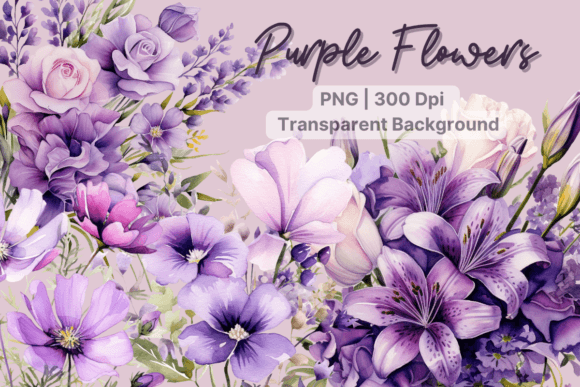
Purple Flowers Watercolor Flower Clipart
First Impressions: Soft, Lyrical, and Quietly Bold
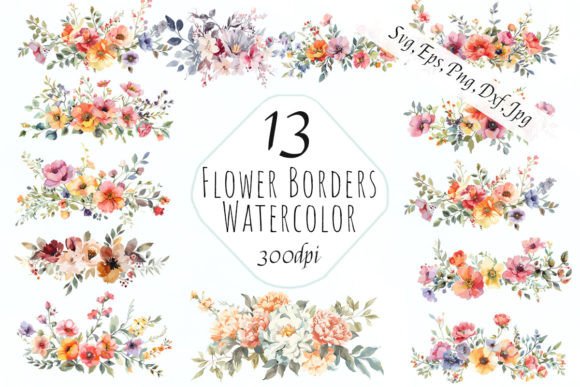
Opening the ZIP file for Purple Flowers Watercolor Flower Clipart, I paused—not because it’s flashy, but because it *breathes*. These aren’t stiff vector blooms or over-saturated clipart flowers. They’re loose, painterly, and intentionally imperfect: soft edges, subtle pigment pooling, delicate gradients from lavender to plum to dusty violet. There’s a gentle asymmetry in the stems and petal placement—no rigid symmetry here—and that’s exactly what makes them feel handmade, not algorithmic. As an embroidery designer who’s stitched hundreds of floral motifs, I immediately saw their potential on a linen tea towel, a baby onesie, or the curved front panel of a structured tote bag.
Where This Design Truly Shines (and Why It Fits Real Projects)
I recently used one of the seven PNGs to develop a custom embroidered tote for a local botanical boutique. The design went onto natural unbleached canvas—medium weight, slightly textured—and the watercolor softness translated beautifully into satin-stitched petals with light fill stitch centers. Customers responded not just to the color, but to the *mood*: calm, thoughtful, quietly elegant. That’s the real strength of Purple Flowers Watercolor Flower Clipart. It doesn’t shout—it invites. It works exceptionally well for:
- Personalized gifts: Baby blankets, nursery pillows, wedding guest towels—where delicacy and warmth matter more than precision.
- Small shop merchandise: Aprons for artisan bakeries, sweatshirt fronts for indie bookshops, pillow covers for slow-living home brands.
- Etsy seller assets: As a base for printable mockups or layered digital embroidery files—especially when paired with minimalist typography or hand-lettered quotes.
- Holiday and seasonal projects: Think lavender sprigs on Easter linens, soft purple blossoms on Mother’s Day tea towels, or subtle floral accents on autumnal kitchen sets.
What to Watch For: Texture, Scale, and Fabric Behavior
Watercolor aesthetics don’t always translate cleanly to thread—especially at small scales or on challenging substrates. Here’s what I tested and observed:
- On thin or stretchy fabric (like lightweight cotton jersey or baby knit), fine details—like wispy stamen lines or faint petal veins—can blur during stitching unless stabilized generously. Use cutaway + tear-away combo stabilizer, not just basic tear-away.
- On dark fabric, the subtlety becomes a challenge. Those pale lavender washes need richer thread contrast—deep plum or charcoal grey satin stitch instead of pastel lilac—to retain legibility. Always test thread colors on scrap first.
- In small hoop sizes (e.g., 4” x 4”), avoid shrinking the largest PNG beyond ~70%. Tiny versions lose their watercolor soul—edges harden, gradients flatten, and the design reads as generic rather than expressive.
- On curved surfaces like caps or mugs (for heat-transfer mockups), choose the simpler, bolder variants from the set—the ones with stronger silhouette definition hold up better under distortion.
Design Integrity Meets Customer Trust
When your customer sees “hand-embroidered” on a product listing, they’re buying intention—not just labor. Purple Flowers Watercolor Flower Clipart supports that promise because its imperfections read as human-made, not mass-produced. That matters for Etsy sellers and craft fair vendors: buyers notice when a floral motif feels *alive*, not templated. On a personalized gift—say, a monogrammed pillow with a trailing vine from this set—the watercolor softness makes the piece feel curated, not copied. It also pairs seamlessly with other hand-drawn elements in your brand’s visual language, reinforcing consistency across digital products, packaging, and finished goods.
Practical Notes Every Embroidery Designer Should Keep Handy
Before digitizing or stitching Purple Flowers Watercolor Flower Clipart, do these five things:
- Test on scrap fabric—same weight and weave as your final project—to assess how gradients translate into stitch density and thread blending.
- Review small details in black-and-white mockups. If a petal edge disappears in grayscale, it’ll likely vanish under thread coverage or lighting.
- Compare light vs. dark background previews. Some PNGs have very low-contrast shadows—these may need slight brightness/contrast tweaks before digitizing.
- Confirm licensing terms before selling finished embroidered items commercially—or bundling the PNGs into digital embroidery files for resale. This is a Graphics asset, not a pre-digitized machine embroidery design.
- Check resolution integrity after resizing. Though the files are 300 DPI, aggressive scaling down can soften edges meant to suggest watercolor bleed—so zoom in and verify clarity at your target output size.
Final Thought: A Thoughtful Tool, Not a Shortcut
Purple Flowers Watercolor Flower Clipart isn’t a “plug-and-stitch” solution. It’s a starting point—with character, restraint, and quiet sophistication. Used well, it elevates handmade products from charming to memorable. Used hastily—without considering fabric, scale, or thread choice—it risks looking vague or unfinished. But for designers who value mood as much as mechanics, who sell to customers seeking meaning in texture and tone, this set earns its place in the toolkit. It reminds us that sometimes the most powerful embroidery designs don’t command attention—they earn it, softly, petal by petal.